Journal · From the Bench
Bench Log: Burgundy Bifold
I’m Gordon Mielke, the sole maker at Rogue Artisan in East Vancouver, cutting and stitching each bifold by hand from full-grain vegetable-tanned leather. A Classic Bifold Wallet starts at $115 CAD, and this bench log shows how a burgundy-dyed hide behaves in real daylight compared to shop lighting — critical for colour accuracy when you’re choosing beyond black or brown, and how that shade evolves with patina over months of use.
Why Burgundy in the First Place?
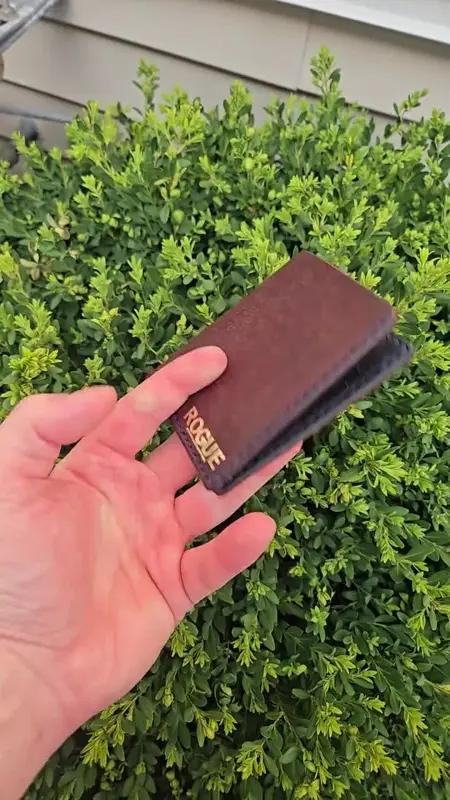
Most folks default to black or brown, but burgundy offers depth without shouting. It’s a colour that hides everyday scuffs better than tan while developing a rich, wine-like patina as the oils from your hands and pockets work into the grain. I use a drum-dyed full-grain vegetable-tanned leather that takes the colour deep — not just a surface stain — so the hue stays true even as the surface wears. You’ll see this in the video clip where I unfold the bifold in the shop doorway: the colour shifts noticeably between the cool, fluorescent shop light and the warm, direct sunlight hitting the leather.
How Light Changes What You See
In the shop, under 5000K LED panels, the burgundy reads cooler, almost plum-like. Step outside into Vancouver’s diffuse daylight — even on an overcast day — and the same leather warms up, revealing red undertones the shop lights swallow. That’s why I always ask clients to view swatches in natural light if they can. The embedded video shows this side-by-side: one shot under the bench lamp, the next in the doorway with morning sun grazing the fold. It’s not about which is “right”; it’s about knowing how the colour will live in your pocket, on your bike commute, or under the fluorescents at work.
Stitching and Construction Details
This bifold uses two needles, 0.6mm polyester thread, and a saddle stitch — each hole punched individually with a diamond chisel, then stitched by hand so if one thread breaks, the seam holds. I stitch at 5–6 spi (stitches per inch) for wallets: tight enough to resist pocket stress, loose enough to let the leather breathe. The edges are trimmed with a beveller, then burnished with water and a canvas slicker — no gum tragacanth here, just friction and time to seal the fibres. You’ll see me running the edge tool along the folded side in the clip; that’s where the burgundy shows most consistently since it’s protected from direct abrasion.
Hide Selection and Thickness
I cut this bifold from a 3–4 oz shoulder section — thick enough to hold shape without bulking, thin enough to fold crisply. Vegetable-tanned leather this weight takes about 3–4 weeks of regular pocket use to start breaking in; the burgundy will deepen noticeably at the corners and along the spine where it flexes. The grain side shows subtle variations from the hide’s natural markings — no two pieces absorb dye identically, which is why I never ship a spec twice. The video shows me laying out the hide, checking for blemishes, and marking the pattern with a silver pencil — all before a single cut.
Colour Beyond the Dye
Dye is just the start. Patina on burgundy isn’t about fading — it’s about oxidation and oil absorption darkening the recesses while the high points stay brighter. Over time, you’ll get a two-tone effect: the raised grain holding a lighter burgundy, the creases turning toward mahogany. That’s why I avoid correcting or buffing the surface after dyeing — what you see in the daylight video is the leather’s true baseline, before your hands change it. If you want to see how this evolves, check the /journal/what-is-patina.html post — it breaks down the science simply.
Watch it happen at the bench
FAQ
Does burgundy leather show dirt more than black?
Not really. Burgandy hides light dust and lint better than tan or natural, though dark denim dye can transfer — same as with any dark colour. A quick brush with a horsehair cloth lifts surface grit without affecting the finish.
Can I get this bifold without the Raven stamp?
Yes. The Raven emboss is +$0 by default; omitting it adds $10. Some clients prefer a clean front panel for initials or a plain look — just say so when you commission.
How does burgundy age compared to Horween Chromexcel?
Chromexcel pulls colour from oils and waxes, so it patinas faster and more dramatically — think rich, uneven highlights. Vegetable-tanned burgundy shifts slower, more uniformly. Both are full-grain; the difference is in the tannage and finish. See /journal/horween-chromexcel-explained.html for the full breakdown.
What thickness should I expect for a burgundy bifold?
3–4 oz vegetable-tanned, about 1.2–1.6mm thick when folded. Thin enough for front pockets, stiff enough to hold cards without sagging. I measure each hide with a thickness gauge before cutting — no guessing.
Can I see the colour in person before committing?
Local pickup is available at the East Vancouver studio. If you’re in the area, I can pull a swatch and we can view it together in daylight — no obligation. Otherwise, I rely on detailed photos and videos like the ones on this page to show how the leather behaves in real light.
Is burgundy available as a custom colour add-on?
Yes. Custom colour is +$8 on top of the base leather. If you want a specific shade of burgundy — more brick, more plum — I can mix or source it, but note that custom dyes may take longer to source and test.
Want to talk through colour options, stitching, or how this bifold would work for your daily carry? Call me at (250) 719-1332 or email info@rogueartisan.ca. We’ll figure it out — no scripts, no push, just leather and straight talk.
See the process: how a leather wallet is made | saddle stitching by hand | cutting leather from a full hide | skiving and edge finishing | leather stamping jig | gallery