Journal · From the Bench
Saddle Stitching by Hand
Every piece leaving this East Vancouver bench is sewn with two needles and a single thread, pulling each stitch tight from both sides so the seam locks on itself — if one thread ever breaks, the rest of the line doesn't unravel. A machine lockstitch can't do that.
What Saddle Stitching Actually Is
Saddle stitching uses one length of thread with a needle on each end. You pierce the leather with an awl, pass the left needle through, then the right needle through the same hole in the opposite direction, and pull both tight. The two threads cross inside the hole, locking the stitch in place. There's no bobbin, no tension spring, no hook racing around a shuttle. Just two hands, two needles, and a thread that binds on itself every single pass.
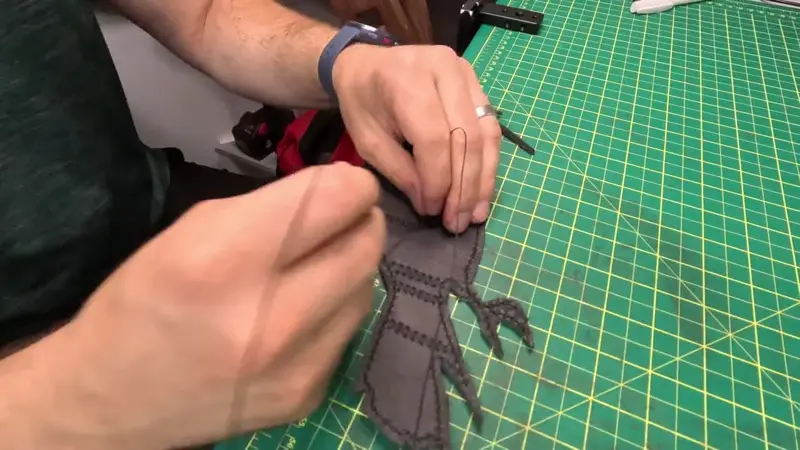
The clips on this page show the rhythm: awl, left needle, right needle, pull, repeat. No speed-up. That's the actual pace.
Why It Holds When a Machine Stitch Fails
The Lockstitch Weak Point
A sewing machine forms a lockstitch by looping a top thread around a bottom bobbin thread. The intersection sits inside the leather. If the top thread snaps — say, from UV degradation, abrasion against a pocket seam, or a sharp edge — the bobbin thread has nothing to hold it. The whole row can unzip like a zipper.
The Saddle Stitch Difference
With saddle stitching, every stitch is an independent knot. The left and right threads cross and cinch inside each hole. If one thread wears through at hole twelve, holes eleven and thirteen are still locked. The seam doesn't travel. I've repaired machine-sewn wallets where a single broken thread let the whole side come apart. A saddle-stitched seam fails one stitch at a time, and even then, it takes deliberate force.
Thread Choice: Linen vs. Polyester
I use waxed linen thread — usually 0.6 mm or 0.8 mm depending on the piece. Linen grips the leather fibres, swells slightly with the wax, and ages with the piece. Polyester is stronger in raw tensile tests, but it slides. It doesn't bite the hole walls the same way. Over years, polyester can saw through the leather at the stitch holes. Linen settles in.
The wax isn't decorative. It lubricates the thread through dense veg-tan, prevents fraying at the needle eye, and adds enough tack that the stitch seats firm before you even pull the second needle through.
Stitch Length and Spacing: 3.5–4 mm for Wallets, Wider for Bags
On a bifold or card holder, I mark stitches at 3.5 mm centre-to-centre using a pricking iron. That's roughly 7 stitches per inch. Tighter than that and you weaken the leather between holes — especially on 2–3 oz Chromexcel. Wider than 4 mm and the seam loses tension control.
On a crossbody bag gusset or belt loop, I'll open it to 5–6 mm. Thicker leather, more stress, fewer holes per inch. The principle stays the same: each stitch carries its share.
Awl Work: The Hole Matters More Than the Thread
You don't punch holes with the needles. You make them with a harness awl — diamond or round, tapered, pushed through at a consistent angle. The awl displaces fibres instead of cutting them. Cut holes (from a rotary punch or chisel) sever fibres and create a clean path for the thread to saw through later. Displaced fibres close back around the thread.
The clips show the awl angle: slightly forward, wrist locked, shoulder driving. Not a stab — a push. Consistency here determines whether the stitch line sits flat or twists.
Edge-to-Edge: No Seam Allowance to Hide Behind
Wallet edges are turned and burnished, not folded over a liner. The stitch line sits 3–4 mm from the cut edge. There's no seam allowance to absorb tension. Every pull transfers directly to the edge. That's why stitch tension has to be even — not just "tight." Uneven tension cups the edge, and no amount of burnishing fixes a cupped edge.
I tension each stitch by feel: firm enough that the thread seats in the awl channel, loose enough that the leather doesn't pucker. It's a tactile calibration, not a torque spec.
Finishing the Thread: Backstitching and Burying
Three backstitches into the previous holes, then the tails get trimmed flush and burnished into the seam with a bone folder. No knots. A knot is a hard lump that presses against the leather from inside. Buried tails disappear. If you ever need to repair it — say, a dog chewed the corner — you can pick out the backstitches and re-sew without damaging the holes.
Time on the Bench
A Classic Bifold Wallet ($115 from) takes about 45–60 minutes of pure stitching once the pieces are cut, skived, and glued. A Crossbody Bag ($265 from) runs 2.5–3 hours at the stitching horse. That's not including prep, edge work, or hardware. The clips on this page are real-time — no time-lapse. You're watching the actual minutes.
Two-tone pieces (like the Raven Edition commissions) add time because you're managing two thread colours and matching tension across the transition. The two-tone clip shows that handoff.
Vancouver Reality: Rain, Transit, Bike Commutes
Wet leather stretches. Dry leather shrinks. A machine stitch set under fixed tension has no give — the thread either snaps or cuts the hole. Saddle stitching with linen has micro-movement. The waxed thread relaxes and re-seats as the leather cycles through wet-dry. I've seen machine-sewn straps fail at the buckle holes after one winter of SkyTrain commutes. Saddle-stitched straps just keep going.
Bike commuters put specific wear on wallet corners — hip impact, pocket friction, rain saturation. The independent stitch lock means a corner abrasion doesn't migrate into a blown seam.
Watch it happen at the bench
FAQ
Is saddle stitching stronger than machine stitching?
In tensile strength per stitch, a machine lockstitch with bonded nylon can test higher. But in field durability — abrasion, UV, flex cycles, single-thread failure — saddle stitching lasts longer because the failure mode is local, not catastrophic.
Can you saddle stitch with a machine?
There are "saddle stitch" machines (like the Cobra Class 4) that mimic the two-needle action, but they still rely on a timed hook and bobbin geometry. They're faster, but they don't replicate the awl-displaced hole or the hand-tensioned seat. I don't use one.
Why not just use thicker machine thread?
Thicker thread needs bigger holes. Bigger holes remove more leather fibre. The seam becomes a perforation line. Hand stitching lets you use fine thread in fine awl holes — maximum leather integrity, maximum stitch count per inch.
Does the Raven maker mark affect the stitching?
No. The embossed Raven mark goes on after construction, usually on an exterior panel away from stitch lines. It's a hot foil or blind impression — surface only. Add or omit it (+$0 / +$10), the stitching underneath doesn't change.
How do I know if a wallet is actually hand saddle stitched?
Look at the back of the stitch line. Hand stitches show a slight angle variation — each hole entered by hand. Machine stitches are mathematically identical. Also check the thread ends: buried tails vs. a chain-stitch tail or melted knot. And the price — a $40 wallet isn't hand-stitched in Canada.
Can you repair a broken saddle stitch?
Yes. Pick the backstitches, re-thread two needles, and re-sew the damaged section using the original holes. The awl channels are still there. It's easier than repairing a machine seam because you're not fighting a locked bobbin loop.
Want a piece sewn this way? Call (250) 719-1332 or email info@rogueartisan.ca. One maker, one bench, East Vancouver.
Home | Custom Leather Wallets | Leather Care in Vancouver Rain | Full-Grain vs. Genuine Leather | How a Leather Wallet Is Made | Cutting Leather from a Full Hide | Start a Commission