Journal · From the Bench
Full-Grain vs Genuine Leather: What You're Actually Buying
I'm Gordon, I cut leather every week in East Vancouver, and I'll say it straight: "genuine leather" is not a quality stamp, it's a floor. Full-grain is the top of the hide, the strongest fibres, the part that develops patina. Genuine is what's left after the good stuff is split off. Here's how I tell them apart on a shelf, and why I only build with full-grain and Horween Chromexcel.
The Leather Grade Ladder, Bottom to Top
A cowhide is thick — usually 4.5 to 6 mm raw. Almost no wallet or bag uses the full thickness, so the hide gets split horizontally into layers. What gets used, and what gets thrown away, is what determines the grade name on the tag.
Bonded Leather
Shavings and dust swept off the splitting floor, glued and pressed onto a fabric backing, then embossed with a fake grain. It's leather the way particle board is wood. Smells like glue, peels at the edges within a year, and you'll find it on cheap belts at the checkout counter. If a price seems too good, it's probably bonded.
Genuine Leather (the confusing middle)
What is genuine leather really? It's the layer left over after the top has been split off for higher grades. The fibres are shorter, the corium side, not the grain side. Manufacturers often emboss an artificial grain on top and spray it with a pigmented finish to look uniform. It doesn't age well — that sprayed surface cracks instead of patinating. The "genuine" stamp just means "contains some leather." It's a legal floor, not a promise.
Top-Grain
The top layer of the hide, but sanded down to remove scars, bug bites, and brand marks, then finished with a pigment or print. More uniform than full-grain, more durable than genuine, but you've paid for the sanding — the strongest, tightest fibres at the very surface have been buffed away.
Full-Grain
The top of the hide, untouched. Hair follicles, pores, small scars, all still there. The grain is the densest fibre structure on the animal, which is why a full-grain wallet outlasts a genuine one by years. It darkens, softens, and takes on a sheen with use. That's patina, and you can only get it from full-grain. I work almost exclusively in vegetable-tanned full-grain and Horween Chromexcel for that reason.
How to Tell Them Apart in a Store
You don't need a loupe. You need ten seconds and your fingers.
Look at the surface
Full-grain has irregular pores you can see and feel. Genuine with an embossed finish looks too perfect, like a repeating wallpaper pattern. Bonded often has a plasticky sheen.
Bend it
Full-grain creases with tight, fine wrinkles that lighten in colour at the fold. Genuine with a heavy pigment finish just compresses flat, or cracks in white lines. If it cracks, the surface is paint, not leather.
Smell it
Real vegetable-tanned leather smells like a saddle or a workshop. Chrome-tanned smells chemical-sweet. Bonded smells like the glue it is.
Check the edges
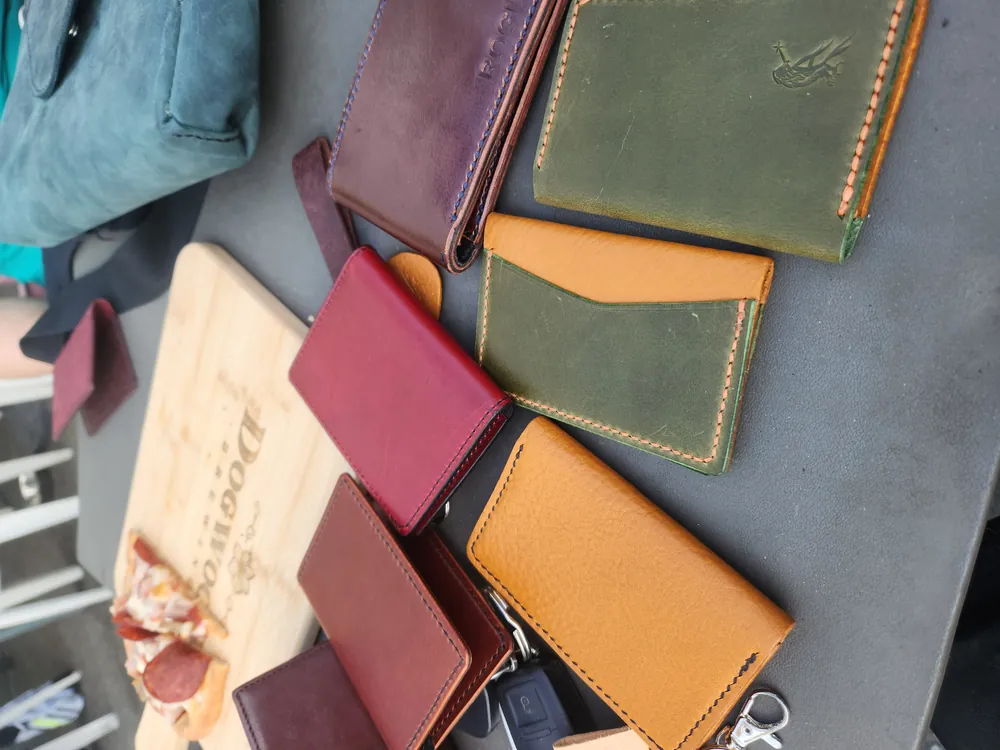
Full-grain edges show dense, fibrous structure when cut. Genuine and bonded show a fuzzy, layered, or fabric-reinforced edge. On my custom wallets, the edges are burnished smooth, but the cross-section still tells you what's inside.
Read the price honestly
A full-grain bifold from a one-person workshop starts around $115 CAD. A genuine leather bifold from a department store costs $30 to $60. The price gap is the material gap. Nobody is losing money on you.
Which Leather Is Best for Wallets?
Best leather for wallets, in plain terms: full-grain vegetable-tanned for structure and patina, Chromexcel for softness and pull-up from day one. Both handle the abuse of a back pocket, Vancouver rain, and being sat on. A genuine leather wallet will do the job for a season or two. A full-grain one will do the job for a decade.
Thickness matters too. I cut wallet bodies at 1.2 to 1.5 mm (about 3.5 to 4 oz), card slots thinner so they don't bulge. For belts, I'm working at 3.5 to 4.5 mm (10 to 12 oz) because the belt has to carry a load without stretching. That thickness grading is its own subject, but the rule is the same: full-grain at the right weight beats any grade at the wrong weight.
Why "Genuine" Gets Marketed So Hard
Because the word is technically true. A tag that says "Genuine Leather" is not lying, the way a bottle labelled "Contains Juice" might contain 5%. The hide is in there, just not the best part of it. Big brands like the word because it lets them charge more than bonded without committing to the cost of full-grain. Smaller makers tend to skip the word entirely and tell you the actual tannage and grade, because that's the information that matters.
What I Actually Use at the Bench
Two leathers, mostly. Horween Chromexcel, a chrome-tanned hot-stuffed leather made in Chicago, soft, waxy, with that signature pull-up where the colour shifts when you bend it. And European vegetable-tanned full-grain, which starts stiff and pale and darkens to a deep honey or chestnut over months of carry. Both are full-grain. Both are checked by hand before any pattern gets laid on them.
Every piece I ship leaves the studio with a Raven maker mark embossed on the inside, unless you'd rather skip it. The hide is the same either way; the stamp is just a signature.
FAQ
Is genuine leather real leather?
Yes, technically. It contains real hide, but usually the lower split layers with an embossed or pigmented surface. It's the lowest grade most stores will put on a shelf, and it won't develop patina the way full-grain does.
Does full-grain leather scratch easily?
It shows marks, yes. Light surface scratches buff out with a thumb or a bit of leather conditioner. Deeper scuffs become part of the patina rather than damage. That's why people who carry full-grain wallets for years end up with something that looks better than the day they bought it.
How long does a full-grain leather wallet last?
With normal use, easily five to ten years before the stitching or an edge needs attention. I've had customers come back after a decade for a new one because the old one finally wore through at a fold. A genuine leather wallet usually starts flaking the surface within two to three years.
Is top-grain leather a bad choice?
Not bad, just different. It's more uniform and often cheaper than full-grain, but the sanding removes the strongest fibres. For upholstery and fashion goods where a perfect surface matters more than longevity, top-grain is fine. For something you carry daily, full-grain is the better bet.
What's the difference between full-grain and Chromexcel?
Both are full-grain. The difference is tannage. Vegetable-tanned full-grain is firm, light-coloured, and develops patina slowly over months. Chromexcel is chrome-tanned and hot-stuffed with waxes and oils, so it's softer, more flexible from day one, and shows pull-up shifts when bent. I let the customer choose based on how they want the piece to feel and age.
Can you tell the difference by price alone?
Not always, but it's a clue. A full-grain wallet from a one-maker shop starts around $115. Anything under $40 claiming "premium leather" is almost certainly bonded or heavily finished genuine. Price isn't proof, but it's a fast filter.
Get in Touch
Questions about a specific hide, a commission, or which leather will suit how you carry? Call (250) 719-1332 or email info@rogueartisan.ca and I'll tell you straight what I'd build it in.