Journal · From the Bench
Bench Log: Leather Pouch Build
Gordon Mielke builds custom leather pouches one at a time in East Vancouver — full-grain veg-tan or Horween Chromexcel, saddle-stitched, edges burnished by hand. Prices start around $85 for a dice/EDC tray-style pouch; tool and gear pouches scale up from there depending on gusset depth, hardware, and leather choice.
What the bench clips show
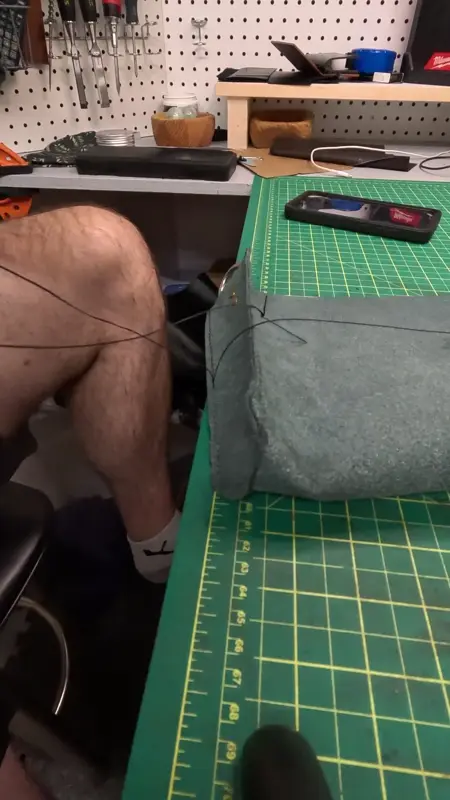
Two short, unedited clips sit on this page. The first follows a pouch coming together: panels cut, glued, stitched, edges dressed. The second zooms in on gluing up small panels — how much cement, where it hits, and the clamp time before stitching. No narration, no jump cuts. Watch them first, then read the notes below.
Gusset choices: expandable vs. flat
A pouch lives or dies by its gusset. Three ways I build them, each for a different job:
Flat (no gusset)
Two panels, one seam per side. Thin profile, zero expansion. Good for a Field Notes cover, a passport sleeve, or a card pouch that rides in a jacket breast pocket. I skive the edges to 2–3 oz so the seam doesn’t bulk at the corners.
Single-piece folded gusset
One long strip forms bottom, sides, and top flap — folded at the base, stitched up the sides. Clean interior, no extra seam at the bottom. Works for tool pouches that need a wide mouth and a flat bottom so they stand open on a bench. Typical leather: 5–6 oz veg-tan for structure, 3–4 oz Chromexcel if the owner wants softer break-in.
Set-in gusset (separate side panels)
Front, back, and two side strips. More layout work, more stitching, but you control volume precisely. I use this for camera battery pouches, med-kit sleeves, or anything with a fixed rectangular footprint. The side panels get a slight taper so the pouch doesn’t balloon at the top.
Sizing around what it carries
Measure the kit first. Not the “max dimensions” — the working dimensions.
Length and width
Add 3–4 mm per side for leather thickness and stitch clearance. A 110 mm knife needs a 118 mm interior. If the item has a clip or lanyard loop, add that too.
Depth (gusset height)
Stack the items, measure the stack, add 6–8 mm so the flap closes without tension on the stitches. A tool pouch for a multi-bit driver, two bits, and a small flashlight: stack is 28 mm, so I cut a 36 mm gusset.
Flap overlap
Minimum 35 mm overlap for a snap or tuck lock. If the pouch rides on a belt horizontally, I add 10 mm more so the flap doesn’t catch when you sit.
Leather weight and break-in
- 3–4 oz Chromexcel: supple day one, forms a patina fast, edges round over in a month of pocket carry. Best for flat pouches, card sleeves, light EDC.
- 5–6 oz veg-tan: stiff out of the gate, needs a week of use to relax. Holds a box shape without collapsing. My default for tool pouches, axe guards, belt-mounted gear.
- 7–8 oz veg-tan: structural. Sheaths, heavy tool rolls, pouches that take a beating on a jobsite. Edges take longer to burnish but stay crisp for years.
Vancouver rain note: Chromexcel handles wet better — oil content repels water, and the pull-up hides scratches. Veg-tan darkens, stiffens when soaked, then dries lighter. I hit veg-tan pouches with a light coat of beeswax-based dubbin before they leave the bench if they’re headed for daily bike commuting.
Stitching: saddle stitch, two needles, one thread
Every seam is hand-saddle-stitched with 0.8 mm braided polyester thread (Tiger Thread or MeiSi). Stitch length 3.5–4 mm depending on leather thickness. Awl holes punched at a slight angle so the thread locks into the grain layer, not just the flesh side. Backstitch three holes at each end, then burnish the thread ends flat with a bone folder — no melted knots.
Edge finishing: no paint, just friction and time
Skive to 1.5 mm at the edge, bevel 45°, then burnish on a canvas wheel with gum tragacanth. Three passes, heat between each. On Chromexcel I skip the trag — just water and canvas, then a fingertip of neatsfoot. The edge seals itself. On veg-tan I’ll do a final wax rub (beeswax/carnauba 3:1) for water resistance.
Hardware that lasts
Solid brass snaps (Line 24), Chicago screws for removable straps, stainless D-rings if the pouch hangs. No plated pot metal. I set snaps with a hand press and a hardened die — whack it once, check alignment, whack again. If the leather compresses over time, the snap still catches because the post is long enough to engage through the thickened edge.
Pattern layout from a full hide
I cut each pouch from a single side, grain oriented so the fold runs parallel to the backbone — strongest direction. Gusset strips come from the belly if they’re narrow; otherwise the shoulder for consistent thickness. The Raven maker mark goes on the interior flap, centered, 10 mm from the top stitch line. You can skip it (adds $10) but it’s there by default.
Common pouch types from the bench
Tool pouch / fastener pouch
Set-in gusset, 6 oz veg-tan, belt loop on back, snap flap. Holds driver bits, pencils, a small square. Stands upright on a sawhorse.
EDC organizer pouch
Folded gusset, 4 oz Chromexcel, two interior slip pockets, pen loop. Flat enough for a front pocket, expands for a power bank and cable.
Knife / multi-tool sheath pouch
Flat or minimal gusset, 7 oz veg-tan, welted edge so the blade never touches stitches. Belt slot or static-line clip.
Medical / trauma pouch
Set-in gusset with internal elastic loops, 5 oz veg-tan, red Chromexcel pull-tab for one-handed opening. Sized to the specific kit — tourniquet, gauze, shears.
Watch it happen at the bench
FAQ
What’s the difference between a pouch and a sheath?
A sheath hugs one specific item — knife, axe, flashlight — usually flat or minimal gusset, often welted. A pouch has volume for multiple items or irregular shapes, and a gusset that lets it expand. Some pieces blur the line; I build what the carry demands.
Can you make a pouch to fit my exact tool roll?
Yes. Send the loaded roll’s dimensions (L × W × H) and a photo. I’ll add the clearance and mock a pattern in cardstock before cutting leather.
How long does a custom pouch take?
One-maker shop, made to order. Typical lead time is 2–4 weeks depending on queue. I’ll give a real date when you inquire.
Do you ship outside Canada?
Canada only right now. Local pickup in East Vancouver if you’d rather skip shipping.
What if I want a weird leather — shell cordovan, kangaroo, reclaimed?
Bring it. If I can stitch it and it’ll hold up, I’ll use it. Surprise Weird Leather add-on is $0 if you supply the hide; +$20 if I source a premium side.
Want a pouch built around what you actually carry? Call (250) 719-1332 or email info@rogueartisan.ca. We’ll size it on the bench.
Home · Custom Leather Wallets · Card Holders · EDC Trays & Key Fobs · Saddle Stitching by Hand · Cutting Leather from a Full Hide · Skiving & Edge Finishing · Start a Commission