Journal · From the Bench
Bench Log: Card Wallet Build
Gordon Mielke builds minimal card wallets one at a time in East Vancouver — full-grain veg-tan or Horween Chromexcel, saddle-stitched by hand, priced from $65 for a Card Holder and $40 for a Compass Card Sleeve. No batch runs, no outsourcing.
What the Clips Show
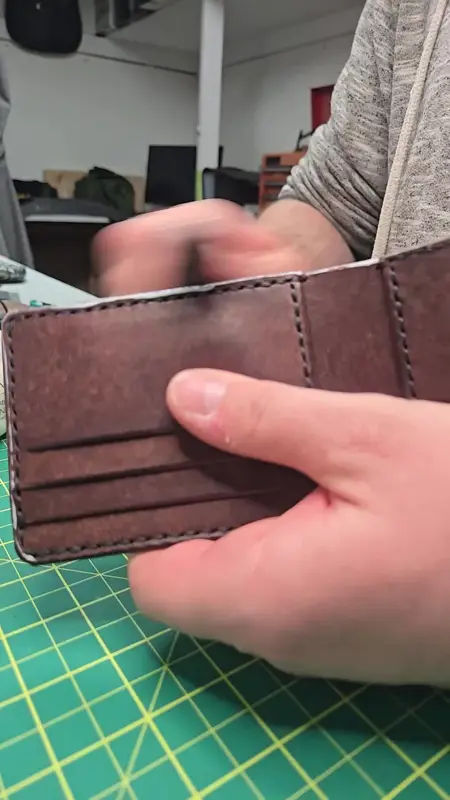
The first clip on this page shows a card wallet fresh off the bench — edges burnished, pockets settled, Raven mark stamped (or omitted, your call). The second catches the layout stage: steel ruler, wing dividers, a scratch awl marking stitch lines on the flesh side before any blade touches leather. The third is the cutting mat — a clicker knife or round knife following those lines, grain side up, waste falling away. That is the actual sequence: mark, cut, skive, glue, stitch, finish. No montage edits.
Pocket Counts That Actually Work
Two Pockets, One Thumb Slot
The Card Holder runs two main pockets plus a centred thumb slot on the back. Each pocket takes 4–6 cards comfortably; the slot lets you push the stack up without pinching fingertips. I cut the pocket bags from 2.5 oz veg-tan — thin enough to keep the overall profile under 6 mm loaded, thick enough to hold shape after a year of transit taps. The thumb slot is radiused on the inner edges so it doesn't cut into the leather above it.
Single Pocket for Compass Cards
The Compass Card Sleeve is a different beast: one pocket, no thumb slot, cut from 3 oz Chromexcel. TransLink readers need the card sitting flush against the sensor — any air gap from a bulky wallet kills the read. This sleeve holds the card at 3.5 mm total thickness. The pocket opening is trimmed 2 mm shy of the top edge so the card never fully ejects when you pull it. Rounded bottom corners prevent the card corners from peeling the stitch line over time.
Why Not More Pockets?
Every extra pocket adds two glue lines, two stitch rows, and 0.8 mm of leather sandwich. Past three pockets you're carrying a brick. Most people carry 6–8 cards total — two pockets plus a centre slot covers it. If you need ID window, cash strap, or coin pocket, that's a different build (bifold, long wallet) — not a card wallet.
Sizing Around the Compass Card
A standard credit card is 85.6 × 53.98 mm. A Compass Card is the same ISO 7810 ID-1 size — but the antenna coil sits 3 mm in from the edges. If the wallet pocket grips the card tight at the coil zone, the reader sees a weak signal. I leave 1.5 mm clearance on the long edges and 2 mm on the short edges. The pocket depth stops 5 mm short of the card bottom so you can pinch it out one-handed on a moving bus.
Chromexcel stretches 1–2% cross-grain over the first month. Veg-tan barely moves. I cut the Chromexcel sleeve 1 mm oversize on width knowing it will relax to a perfect friction fit. Veg-tan gets cut dead-on. That difference is why the two models feel different in hand even though the pattern looks identical.
Break-In: What Actually Happens
Week One — Tight By Design
Fresh veg-tan pockets grip cards like a vise. That's intentional. The fibres haven't relaxed; the stitch holes haven't seated. Force the cards in anyway — don't sand the pockets, don't oil them. The pressure seats the saddle stitch and compresses the fibres evenly. Chromexcel feels looser day one because the oils already did that work at the tannery.
Week Two to Four — The Sweet Spot
Veg-tan pockets ease to a smooth slide. Cards enter and exit with a quiet shhk — no snag, no rattle. The thumb slot rounds further from thumb pressure. Edges darken where your fingers land. This is the wallet's working life. It stays here for years if you don't overstuff it.
Month Six Plus — Honest Wear
Veg-tan develops a caramel patina on the grain surface; Chromexcel pulls up a waxy sheen. Stitch holes don't elongate — saddle stitch locks each stitch independently. The only failure mode I've seen is someone cramming 12 cards into a two-pocket wallet until the glue line lets go. Don't do that. Carry what it's sized for.
Stitch & Edge Details
Saddle stitch, 5 stitches per inch, 0.6 mm Ritza Tiger thread (polyester core, waxed). Two needles, one thread — each stitch is a lock. If a thread ever breaks, the rest hold. Machine lockstitch unravels; saddle stitch doesn't. I punch holes with a 3 mm French pricking iron on the stitching horse, stitching pony for the longer runs. Thread tension is set by feel — tight enough to pull the leather sandwich flat, loose enough not to pucker the grain.
Edges: skived to 1.5 mm at the pocket openings, then bevelled, sanded 400 → 800 → 1200 grit, burnished with a canvas wheel and gum tragacanth. No edge paint. The burnish seals the fibres; water beads and rolls off. Re-burnish once a year with a wood slicker if the edge fuzzes.
Hide Selection for This Build
Card Holder: 2.5 oz (1.0–1.2 mm) full-grain vegetable-tanned shoulder. Tight fibre structure, consistent thickness across the hide. I cut pockets from the belly — softer, easier break-in. The shell goes to belts.
Compass Card Sleeve: 3 oz (1.2 mm) Horween Chromexcel. Pull-up effect shows wear fast; the oil content means zero conditioning needed. I click these from the butt — cleanest grain, fewest brands or bug bites. Each hide gets inspected under raking light before a pattern touches it.
Vancouver Realities: Rain, Transit, Bike Commuting
Rain hits the wallet in your back pocket or strap pocket. Veg-tan absorbs water, darkens, then dries stiff — work the leather in your hands for 30 seconds and it softens back up. Chromexcel shrugs off rain; the oils repel it. Neither rots. Neither molds. If your wallet sits wet against denim for hours, the indigo transfers — that's denim, not leather failure.
Transit: Compass Card Sleeve lives in a front pocket or lanyard. Tap and go. Card Holder rides in a jacket chest pocket or bag organizer. Two-handed retrieval is the friction tax of minimal carry. Bike commuting: sweat hits the back of the wallet. Veg-tan wicks it; Chromexcel resists it. Both dry overnight on a desk. No special care.
From the Bench: What the Video Doesn't Show
The clips show mark, cut, stitch. They don't show the 20 minutes of skiving pocket openings on a bell skiver, the 10 minutes burnishing each edge, the wait time for contact cement to flash off before assembly. A Card Holder is 90 minutes of bench time start to finish. A Compass Card Sleeve is 45. The video is the highlight reel; the wallet is the sum of the quiet minutes.
Watch it happen at the bench
FAQ
How many cards fit in the Card Holder?
Each pocket holds 4–6 standard cards. The centre thumb slot adds quick access for your most-used card. Total practical capacity: 8–12 cards without bulking past 6 mm.
Does the Compass Card Sleeve work with tap-to-pay credit cards too?
Yes. Same ISO dimensions, same antenna placement. The sleeve reads through Chromexcel or veg-tan at standard terminal distance.
Will the veg-tan Card Holder stretch out and drop cards?
No. Veg-tan compresses and relaxes, but the pocket opening is cut smaller than the card width. Friction holds. The stitch line doesn't move.
Can I get a Card Holder in Chromexcel instead?
Yes — add the Premium Leather option (+$20). Chromexcel pockets break in faster, feel softer day one, and show pull-up marks sooner. Thickness runs 3 oz so the loaded profile is slightly fatter.
What's the difference between the Card Holder and the Compass Card Sleeve besides pocket count?
Leather weight (2.5 oz vs 3 oz), default material (veg-tan vs Chromexcel), thumb slot vs no thumb slot, and pocket depth tuned for one-handed ejection on transit.
Do you ship across Canada?
Yes. Local pickup in East Vancouver, or shipped anywhere in Canada on request. Contact to arrange.
Ready to commission a card wallet built to your carry? Call (250) 719-1332 or email info@rogueartisan.ca.
Home Custom Leather Wallets Leather Card Holders Leather Passport Sleeves Leather Care in Vancouver Rain Saddle Stitching by Hand Cutting Leather from a Full Hide Start a Commission