Journal · From the Bench
Hot-Foil Stamping on Leather: How It Actually Works at the Bench
Hot-foil stamping on leather is the process of pressing a heated metal die into leather through a thin metallic foil, leaving a crisp metallic impression — usually gold or silver — of initials, a name, or a small mark. At Rogue Artisan in East Vancouver, I run a single brass die in a thermostatically controlled press at roughly 140–160°C for about three seconds per impression. The result is a permanent mark that won't wash off, won't peel under normal use, and ages in a specific way I'll show you below.
What the press actually is (and what it isn't)
A hot-foil press is not a laser, not an embossing-only machine, and not a printer. It's a cast-iron or steel frame with a heated upper plate and a stable lower platen. The die (the raised metal letterform) clamps into the upper plate. Foil feeds between the die and the leather. Heat and pressure transfer the foil's metallic layer onto the leather surface in one dwell.
For wallet work I use a small desktop press — about a 10×15 cm throat — which is plenty for a monogram corner, an inside-panel stamp, or a maker mark. Larger presses exist for bigger panels, but for the kind of work I take on, a benchtop unit is the right tool. The press has one job: hold steady temperature, hold steady pressure, and let me control dwell time by hand or foot pedal.
The die: brass, magnesium, or steel
Most of my dies are brass. Magnesium is cheaper and fine for short runs; steel lasts longer but costs more and is overkill for initials. A brass die for a three-letter monogram is small — roughly the size of a thumbnail — and sits in a magnetic or mechanical holder on the upper plate.
Die depth matters more than people think. Too shallow and the foil barely transfers; too deep and you crush the leather's grain. For vegetable-tanned leather I run dies around 0.6–0.8 mm relief. For Chromexcel, which is softer and oilier, I'll back the dwell time down a touch because the surface compresses more easily.
Temperature, pressure, and dwell
Three variables control the result. Get any one wrong and the foil either doesn't transfer or burns the leather.
- Temperature: 140–160°C for most veg-tan. Chromexcel runs cooler, around 130–145°C, because the wax and oil content scorches faster.
- Pressure: firm, even, no rocking. The press does this — my hand just guides the leather into position.
- Dwell: 2.5–4 seconds. Less than two and the foil lifts patchy. More than five and the leather darkens past the stamp and the foil loses its mirror finish.
I always do a test strike on a scrap from the same hide before going onto the finished piece. Every hide behaves slightly differently — a dry veg-tan takes foil cleanly; a waxy pull-up needs a hair more heat.
The foil itself
Hot-stamp foil is a thin polyester carrier with a release layer, a lacquer layer, and the metallic pigment. It comes in rolls, usually 100–200 mm wide, and I cut strips to size. Gold and silver are the common colours; I also keep a few odd rolls — copper, black satin, even a holographic one I use sparingly.
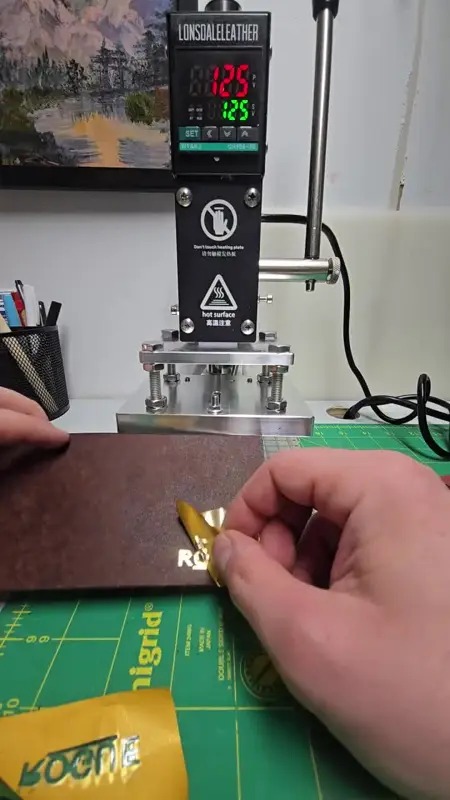
The foil is single-use. Each impression burns off a tiny patch of the metallic layer onto the leather. You can see this in the workshop clip where I peel back the foil after the press lifts — the used section goes dull and the leather underneath holds the shine.
Where the stamp goes on a wallet
Placement is half the job. The standard spots:
- Lower right corner, exterior: the most common. Reads as the owner's mark.
- Inside, on the card pocket panel: more discreet, often used for gift pieces.
- Inside, on the spine fold of a bifold: visible only when opened — a quiet choice.
For a personalized leather wallet order, I usually confirm placement with the customer before stamping. A monogram off-centre by a few millimetres looks careless, and there's no undoing it. I measure twice, mask with low-tack tape if needed, and strike once.
What it looks like fresh off the press
A fresh gold stamp is mirror-bright. The foil sits on top of the leather with a slight raised edge where the die pressed in. On a brand-new piece, the contrast between the bright foil and the matte leather is striking — that's the look most people picture when they order custom initials on a wallet.
Within a few days of pocket carry, the foil loses a little of its mirror sheen. That's normal. The metallic layer is bonded to the leather surface, but it isn't a plating — it's a transferred film, and the surface of it will micro-scratch the way any soft metal does. After a year, a well-worn gold stamp reads as a warm, slightly muted gold rather than a foil sticker. After several years, it's part of the patina.
How the stamp ages over years
This is the part I care about most, and the part most online guides skip. A hot-foil stamp doesn't disappear. It doesn't flake off like a printed logo. It slowly integrates with the leather.
On a full-grain vegetable-tanned wallet, the leather around the stamp will darken with sun and skin oils faster than the foil itself. The gold stays roughly the same brightness while the surrounding leather shifts from natural tan to a deep caramel. The contrast actually gets better with age, not worse.
On Chromexcel, the foil sits on a waxier surface. The wax migrates over time and the foil picks up a faint patina of its own — the gold becomes slightly warmer, less yellow. I've got an older Chromexcel piece on the bench with a six-year-old stamp and the gold has taken on a soft, almost antique quality. That's the patina behaviour people talk about with leather, applied to the foil as well.
Scratches and dents will show on the foil the way they show on the leather. A deep scratch across a gold monogram is permanent — the foil layer is thin. But light wear just dulls it slightly, which most owners prefer.
Common mistakes I see on cheaper work
Not all gold stamps are created equal. A few things to watch for if you're comparing makers:
- Too hot, too long: the leather darkens in a halo around the stamp and the foil looks sunken. This is irreversible.
- Wrong foil for the leather: some foils are formulated for paper or plastic and don't bond to leather's fibre structure. They peel within weeks.
- Shallow dies: the stamp looks grey and incomplete because not enough foil transferred.
- Stamping over a finished/sealed surface: if the leather has a heavy topcoat, the foil won't bond. I stamp before any finish goes on, or on bare leather.
At my bench, I stamp on the finished, dry leather, before any conditioner is applied. Conditioner after stamping will slightly mute the foil's shine, which some customers actually want — a more subtle, broken-in look from day one.
Why I do this by hand instead of outsourcing
Rogue Artisan is a one-person shop. I cut, stitch, edge-finish, and stamp every piece myself. Outsourcing stamping means trusting someone else with the placement, the temperature, and the foil choice. I'd rather keep it on the bench where I can fix a bad strike before it leaves the shop. If a stamp goes wrong, I start that panel over — there's no patch.
Watch it happen at the bench
FAQ: Hot-foil stamping on leather
How long does a hot-foil stamp last on a leather wallet?
A properly executed hot-foil stamp is permanent. It won't wash off, won't peel, and won't fade under normal use. The metallic sheen softens slightly over years of pocket carry, but the mark itself stays legible for the life of the leather.
Can you stamp on any colour of leather?
Yes, but contrast matters. Gold foil reads best on dark or medium leathers — black, brown, burgundy, natural tan. Silver foil works well on darker hides too. On very light leathers like natural undyed veg-tan, gold can look harsh; I'll sometimes suggest a copper or a darker foil for a softer read.
What's the difference between hot-foil stamping and embossing?
Embossing presses a shape into leather with no colour transfer — you get a debossed impression only. Hot-foil stamping adds the metallic foil layer on top of the impression. You can emboss without foil, but you can't get a gold stamp without the heat-and-foil process.
Can you stamp an existing wallet I already own?
Generally no. I only stamp pieces I've made, because I need to know the leather type, finish state, and thickness to set temperature and dwell correctly. Sending an outside wallet through the mail for stamping risks damage I can't take responsibility for.
What does gold foil stamping cost on a Rogue Artisan piece?
On made-to-order commissions, a Raven Stamp (the maker's mark) is included. A custom monogram in gold or silver is a small add-on — get in touch with the initials and I'll quote it as part of the build. Foil choice and stamp location both factor in.
Will the Vancouver rain affect a foil stamp?
Rain won't hurt a properly bonded foil stamp. The metallic layer is sealed onto the leather surface by the heat-and-pressure bond. That said, I recommend the same basic leather care you'd use for the rest of the wallet — let it dry slowly if soaked, and condition occasionally.
Want a monogram, initials, or a small custom mark on a piece? Send the letters, the foil colour, and the placement you have in mind to info@rogueartisan.ca or call (250) 719-1332 and we'll work it into the build. Watch the stamping clips further down the page to see the press in action.